When founders choose a business name, they are usually thinking about branding: what sounds right, what fits the vision, and what will resonate with customers.
Those are the right considerations. But from a trademark perspective, there are other questions that are just as important:
What makes a strong trademark? And is this a name we can actually protect?
What is not always obvious at the outset is that not all names are equally strong from a trademark standpoint. Some are easier to register, enforce, and build around. Others can create limitations that only become clear later.
A Strong Trademark Starts with Distinctiveness
From a legal perspective, trademark strength is largely about distinctiveness.
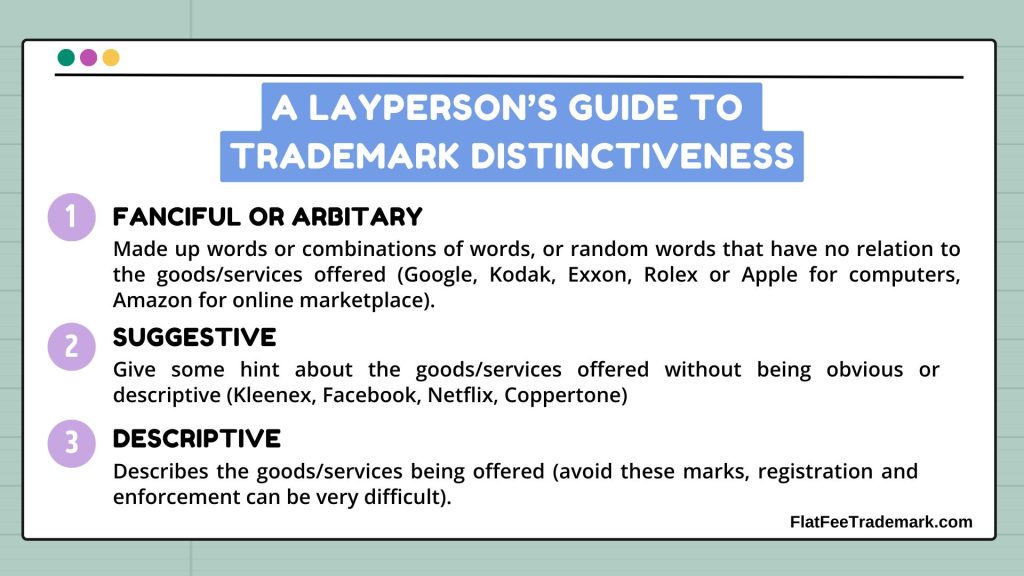
Names are generally evaluated along a spectrum:
- Fanciful marks — made-up terms (e.g., Pepsi)
- Arbitrary marks — common words used in an unrelated way (e.g., Apple for computers)
- Suggestive marks — hints at the product or service without directly describing it
- Descriptive marks — describes a feature, quality, or function of the product or service (to be avoided)
- Generic terms — name of the product or category itself (to be avoided at all costs, these marks are unregistrable)
A strong trademark looks, sounds, is spelled differently, and creates a different commercial impression compared to other marks. The more distinctive the name, the easier it is to protect.
Descriptive and generic terms, while often appealing from a branding standpoint, tend to be more difficult to register and enforce because they are used by many businesses in the same space.
Where Things Become More Complicated
What makes a strong trademark is not always obvious when a business is getting started.
A name can feel like a perfect fit – clear, intuitive, and aligned with the product or service – while still sitting in a crowded or descriptive space from a trademark perspective.
One example I often share is our own name, FlatFee Trademark. It’s a clear and straightforward name that reflects what we do, and it has served our business well over time. At the same time, it operates in a more descriptive space, which can make enforcement more nuanced than it would be with a more distinctive mark.
We were fortunate to adopt the name early and build recognition over many years, but it’s a useful reminder that even well-considered brand names can involve tradeoffs.
A Common Misstep: Adding Descriptive Words
When a trademark search reveals a potential conflict, one of the most common reactions is to try to “fix” the name by adding extra wording.
We see this frequently with terms like:
- “Company”
- “Naturals”
- “Partners”
- “Supplements”
- “.AI”
In most cases, this does not solve the underlying issue.
From a trademark perspective, these additions often have very little distinguishing value. The USPTO may require the applicant to disclaim those descriptive or generic terms, meaning you do not have exclusive rights to them.
In practical terms, that means the core, or dominant, portion of the mark is still what matters. If that portion is too close to an existing trademark, adding descriptive wording is unlikely to overcome the conflict.
What Happens When a Name Is Weak or Unavailable
When a name sits in a descriptive or crowded space, a few things tend to happen:
- applications may be refused based on likelihood of confusion
- protection may be limited even if registration is obtained
- enforcement becomes more difficult
- expansion into new products or services can create additional conflicts
These issues are not always immediate, but they tend to surface as the business grows.
When a Pivot Is the Better Decision
One of the more important moments in the process is when a trademark search reveals that a name may not be available or presents meaningful risk.
At that point, businesses are faced with a choice: move forward with a compromised position, or step back and reconsider the name.
While pivoting can feel like a setback, it is often the point where a business still has flexibility. Before significant investment has been made in marketing, packaging, and customer recognition, there is still an opportunity to choose a stronger, more distinctive name.
In advising clients through this process, we often focus on:
- selecting names that are more distinctive
- avoiding crowded or highly descriptive terms
- considering how the brand may evolve over time
- ensuring the name can support both current use and future growth
A thoughtful pivot at this stage can prevent far more disruptive and costly changes later.
Choosing a Name You Can Build Around
A trademark is not just a filing—it is the legal foundation for the name a business intends to build.
A strong, distinctive name makes it easier to:
- register and maintain your trademark
- enforce your rights against competitors
- expand into new markets or product lines
- invest in your brand with confidence
A weaker name may still work from a branding standpoint, but it often comes with limitations that become more noticeable over time.
Final Thought
Choosing a name is one of the earliest decisions a business makes.
Taking the time to choose one that is not only appealing, but also protectable, can make it significantly easier to build, protect, and grow your brand over the long term. We’ve worked with hundreds of business owners and enterprise companies to select strong brand names from the outset or to rebrand after years in business. Contact us today to book a complimentary consultation with one of our licensed U.S. trademark attorneys.
More About This Article