U.S. Trademark Registration for Non-U.S. Companies (Complete 2026 Guide)
If your company is based outside the United States and plans to sell products or services in the U.S., you will likely need a U.S. trademark.
[TL;DR] Here are the key points to know upfront:
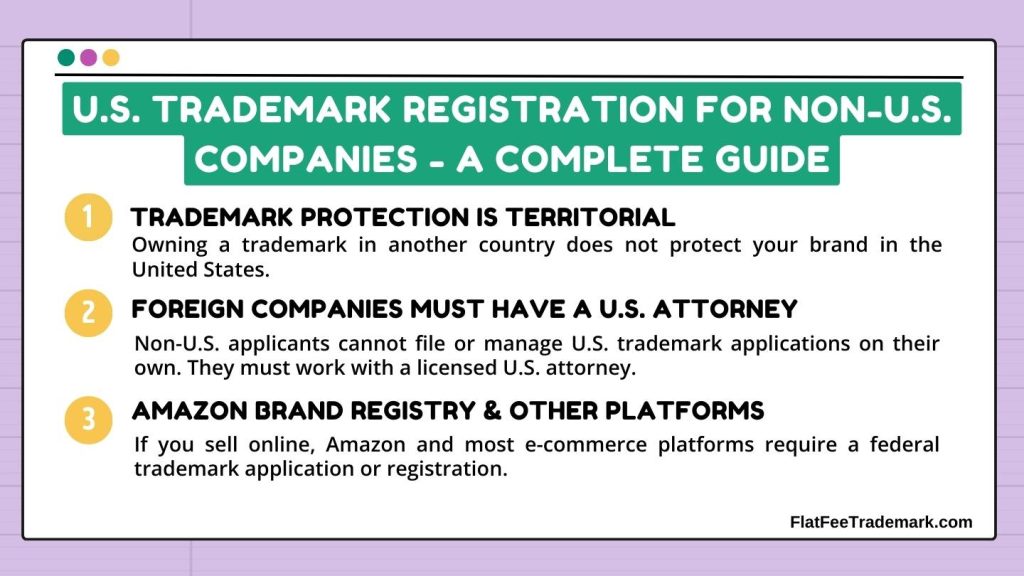
- U.S. trademark protection is territorial. Owning a trademark in another country does not protect your brand in the United States.
- The USPTO requires foreign companies to be represented by a licensed U.S. trademark attorney. Non-U.S. applicants cannot file or manage U.S. trademark applications on their own.
- A U.S. trademark is often required for Amazon Brand Registry and other e-commerce platforms.
- Choosing the correct owner, filing basis, and goods/services description is critical. Mistakes can delay or invalidate a registration.
Early trademark planning reduces risk. Addressing trademark protection before launching or marketing in the U.S. helps avoid refusals, rebranding, and enforcement issues.
This guide explains how U.S. trademark registration works for non-U.S. companies, what the U.S. Patent and Trademark Office (USPTO) requires, and how international businesses can protect their brands effectively.
If you are a non-U.S. company planning to sell products or services in the United States, registering a U.S. trademark is one of the most important legal steps you can take to protect your brand.
U.S. trademark law is different from many other countries, particularly when it comes to use requirements, filing strategy, and mandatory attorney representation. Many international businesses encounter delays, refusals, or enforcement problems simply because they are unfamiliar with how the U.S. system works.
Who This Guide Is For
This article is written for:
- Non-U.S. companies entering the U.S. market
- Foreign startups expanding operations to the United States
- International Amazon, Shopify, and e-commerce sellers
- Overseas brand owners seeking U.S. trademark protection
Why U.S. Trademark Registration Matters for International Businesses
A U.S. trademark registration provides:
- Nationwide brand protection in the United States
- Legal rights to stop copycats and infringers
- Eligibility for Amazon Brand Registry and platform enforcement
- Increased brand value for investors, partners, and acquirers
Importantly, owning a trademark outside the United States does not automatically protect your brand in the U.S. Trademark rights are territorial, and U.S. protection must be secured separately.
Do Non-U.S. Companies Need a U.S. Trademark Attorney?
Yes. The USPTO requires all foreign-domiciled trademark applicants to be represented by a licensed U.S. trademark attorney.
This requirement applies if:
- Your company is incorporated outside the United States, or
- Your principal place of business is outside the United States
Foreign applicants cannot file or prosecute U.S. trademark applications on their own—even if they have legal counsel in their home country.
This rule exists to ensure compliance with U.S. trademark law and to reduce fraudulent or improper filings.
How U.S. Trademark Registration Works for Non-U.S. Companies
Step 1: Trademark Search and Clearance
Before filing, a trademark search should be conducted to identify:
- Conflicting trademarks already registered or pending in the U.S.
- Risks of refusal based on similarity with another mark or descriptiveness of the mark itself
Skipping this step is one of the most common, and costly, mistakes made by international applicants.
Step 2: Identifying the Correct Trademark Owner
The trademark owner must be the correct legal entity that uses or intends to use the mark in commerce.
Ownership errors – such as listing the wrong affiliate, parent company, or individual – can invalidate a trademark registration if not addressed early.
Step 3: Drafting an Accurate Goods and Services Description
One of the most critical – and often misunderstood – parts of a U.S. trademark application is the goods and services description.
The description must clearly define what your trademark covers, but it must also comply with strict USPTO requirements.
Why This Step Matters
- Descriptions that are too narrow may limit the scope of your trademark protection and fail to cover your core business activities.
- Descriptions that are too broad may trigger USPTO refusals or objections and can be difficult or impossible to defend.
USPTO Fee Considerations
The USPTO now charges extra government fees when:
- Goods and services descriptions exceed certain character limits (up to 1000), or
- Custom language is used instead of standardized, pre-defined descriptions.
This means that overly long or poorly drafted descriptions can increase filing costs and delay examination.
Strategic Drafting Is Key
For international businesses, drafting the right description requires balancing:
- Legal accuracy
- Commercial relevance
- Cost efficiency
- Long-term brand protection
This is why working with a licensed U.S. trademark attorney is particularly important at this stage. An experienced attorney can help ensure your description is:
- Broad enough to protect your business
- Narrow enough to satisfy USPTO requirements
- Structured to avoid unnecessary fees or objections
Step 4: Choosing the Correct Filing Basis
Non-U.S. companies typically file under:
- Use in Commerce (if already selling in the U.S.), or
- Intent to Use (if planning future U.S. market entry)
Choosing the wrong filing basis can delay registration or trigger USPTO refusals.
Step 5: Filing with the USPTO
Once filed, the application is reviewed by a USPTO examining attorney for:
- Conflicts with existing trademarks
- Compliance with U.S. trademark law
- Proper classification and description of goods and services
Step 6: Responding to USPTO Office Actions
Many trademark applications receive an Office Action, which is a formal refusal or request for clarification.
Office Actions often raise issues related to:
- Likelihood of confusion
- Descriptiveness
- Technical or procedural defects
How these issues are addressed can determine whether a trademark is approved or refused. Applicants have three months to address the issues raised in an Office Action or the application will become abandoned.
Step 7: Publication and Registration
If approved, the trademark is published for opposition. This is a 30-day period where interested parties are able to challenge registration of the trademark by filing a trademark opposition.
If no opposition is filed, the mark proceeds to registration (or a Notice of Allowance for intent-to-use applications). This step can take up to 2-3 months following publication.
For the Notice of Allowance, you’ll have six months to file a Statement of Use showing use of the trademark in U.S. commerce, or request an extension of time to show use (6 months).
Common U.S. Trademark Mistakes Made by Foreign Companies
International applicants often encounter problems due to:
- Filing without a clearance search
- Incorrect trademark ownership
- Overly broad or inaccurate goods and services descriptions
- Assuming foreign trademarks protect U.S. rights
- Relying on automated filing platforms without attorney review
These errors frequently result in delays, refusals, or loss of rights.
Special Considerations for Amazon and E-Commerce Sellers
If you sell products online to U.S. customers:
- Amazon Brand Registry requires a valid U.S. trademark
- Enforcement depends on proper trademark ownership
- Timing mismatches between Amazon and the USPTO are common
Strategic planning is essential to avoid launch delays or enforcement gaps.
Why Working with a U.S. Trademark Attorney Matters
For non-U.S. companies, attorney representation is not just a requirement – it is a risk-management strategy.
A licensed U.S. trademark attorney helps ensure:
- Compliance with USPTO rules
- Strategic positioning of your trademark
- Effective responses to Office Actions
- Long-term brand protection in the U.S. market
Next Steps for International Businesses
If your company plans to operate in the United States, your trademark strategy should be addressed before product launch, marketing investment, or investor outreach.
A properly registered U.S. trademark is a foundational asset for international growth. We can help. We’ve represented hundreds of foreign companies and brands looking to do business in the United States. From China and Australia, to Europe, Africa, Latin America and Canada, we can assist you in navigating the U.S. federal trademark process. Contact us today for a complimentary consultation.
More About This Article